03 / LEVOIT / Premium market growth
Creating new growth through category education and product differentiation.
Consumer insight · Positioning · Product GTM
Thailand · Premium Home · Pet Households
Consumer Insight · Positioning · Product GTM · Channel Strategy

A price gap becomes an opportunity only when product difference, audience behavior and value explanation work together.
Context
Levoit brought a different commercial model from Vinko: higher-ticket home appliances, longer decision cycles and a greater need for product education in Thailand. Within the portfolio, the air-circulator line and the Vital Pet / Pet Pro line were growth products: their job was to reach new audiences and open new demand, rather than only harvest existing purifier demand.
The portfolio also included Core 300S, Core 600S and Core Mini. That broader portfolio context mattered because a new product had to add a distinct role instead of becoming another SKU measured only by launch sales.
Low penetration → AC companion → premium conversion
Cat-led audience → fur + odor → price-band whitespace
Challenge
For the air circulator, low category penetration and a price above ordinary fans created a basic uncertainty: was the empty price band a real opportunity, or evidence of weak demand and high education cost?
For the pet purifier, generic PM2.5 messaging was not enough. The opportunity was to make a specialist proposition for middle- and high-income pet households—especially cat owners—who deal with floating fur, litter odor, dander, limited ventilation and multi-pet living.
Diagnosis
Research for the air-circulator category showed that the product could not be judged inside the ordinary-fan reference frame. Existing air-conditioner-plus-fan behavior provided a real use foundation, while purchase-stage concerns clustered around safety, vertical airflow, ease of cleaning and product comparison.
For the pet line, the strongest whitespace was a specialized air-management product built around a large hair-intake path, hair collection, odor control and practical features for homes with cats and dogs.
Strategy
Reframe the air circulator from “an expensive fan” to an air-conditioner companion and home-air upgrade. Segment the message for existing AC-plus-fan users, quiet-seeking households, design-conscious home users and high-price prospects who need comparison and trust before buying.
Position the pet purifier around three jobs: floating-fur management, odor control and healthier air for pet households. Lead with cat households, use real-room scenarios and make the product difference visible instead of relying on generic purification language.
Use TikTok / GMX for discovery and education, then Facebook / Instagram / CPAS for higher-intent conversion and remarketing. Performance activity and new-product momentum were planned as one system rather than separate tasks.
Execution
For the air circulator, I translated research into category-education and comparison content: air-conditioner companion use, airflow coverage, safety, cleaning and practical product differences. Creator selection emphasized audience and scenario fit over follower count alone.
For the pet line, the launch plan connected social warm-up, problem education, KOL / KOC proof, commerce conversion and offline / event operations. Content showed real filters and fur collection, litter-box and multi-pet scenarios, odor problems, app control and night use. Feature-led CPAS creative was used to test which product difference mattered most.


Result
The air-circulator and pet-purifier lines were successfully developed into new growth products for Levoit Thailand. They expanded the portfolio beyond the mature purifier core and gave the brand two clearer routes to new demand: cross-category home comfort and specialized pet air management.
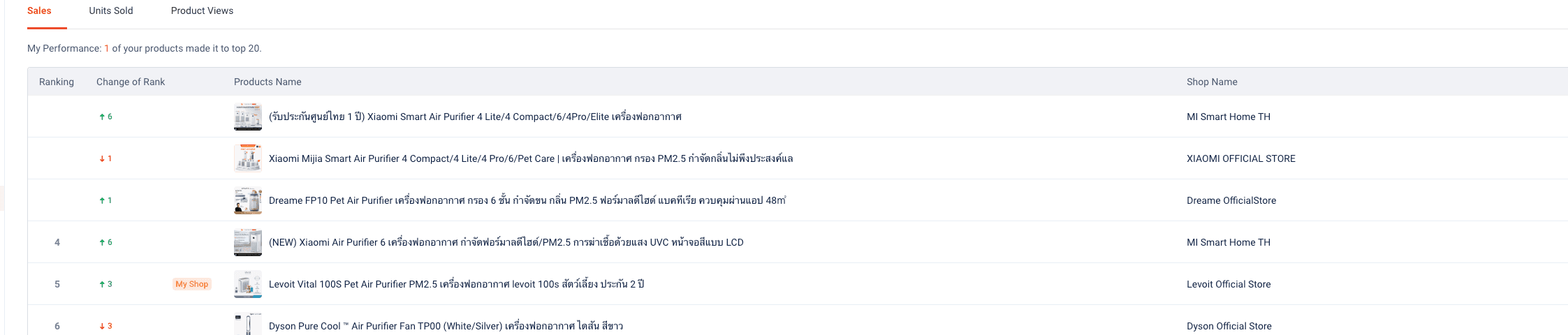
Vital 100S Pet ranked No. 5 in June and No. 4 in both July and August 2026 in Shopee Mall Thailand’s air-purifier ranking—three consecutive months inside the Top 5.


Learning
A market gap is a hypothesis, not a conclusion. It becomes commercially useful only when existing behavior, product advantage, message clarity and education cost all support the same decision.
Growth products should be evaluated by new-audience acquisition, incremental demand, category search, portfolio lift and efficiency after scaling—not only by first-batch sell-out or launch GMV.